Introduction: Pricing is not guesswork — it is a formula
Most newsletter publishers set their ad rates the wrong way. They look at what a competitor charges, halve it to seem affordable, and hope advertisers show up. That approach leaves money on the table, attracts low-quality buyers, and creates a pricing model that cannot scale. The better path is to understand how ad pricing actually works — what inputs drive CPM, how placement and audience quality interact, and how to construct a number that is both defensible to advertisers and profitable for you.
CPM, or cost per thousand impressions, is the standard pricing unit in newsletter advertising. It is the number advertisers use to compare inventory across newsletters, and it is the lever publishers need to understand before quoting a single rate. The challenge is that CPM alone does not tell the whole story. A $50 CPM newsletter with a 55 percent open rate and a highly engaged B2B audience delivers far more value than a $20 CPM newsletter with a 20 percent open rate and a disengaged general audience. Pricing that reflects this difference protects your revenue and builds long-term advertiser relationships.
This guide walks through the complete pricing framework: how to calculate your baseline CPM, what variables push it up or down, how to structure a tiered rate card, how to set price floors for programmatic inventory, and how to revisit rates as your newsletter grows. The goal is a pricing model you can explain to any advertiser in under two minutes and justify with data.
Understanding CPM: The foundational unit of newsletter ad pricing
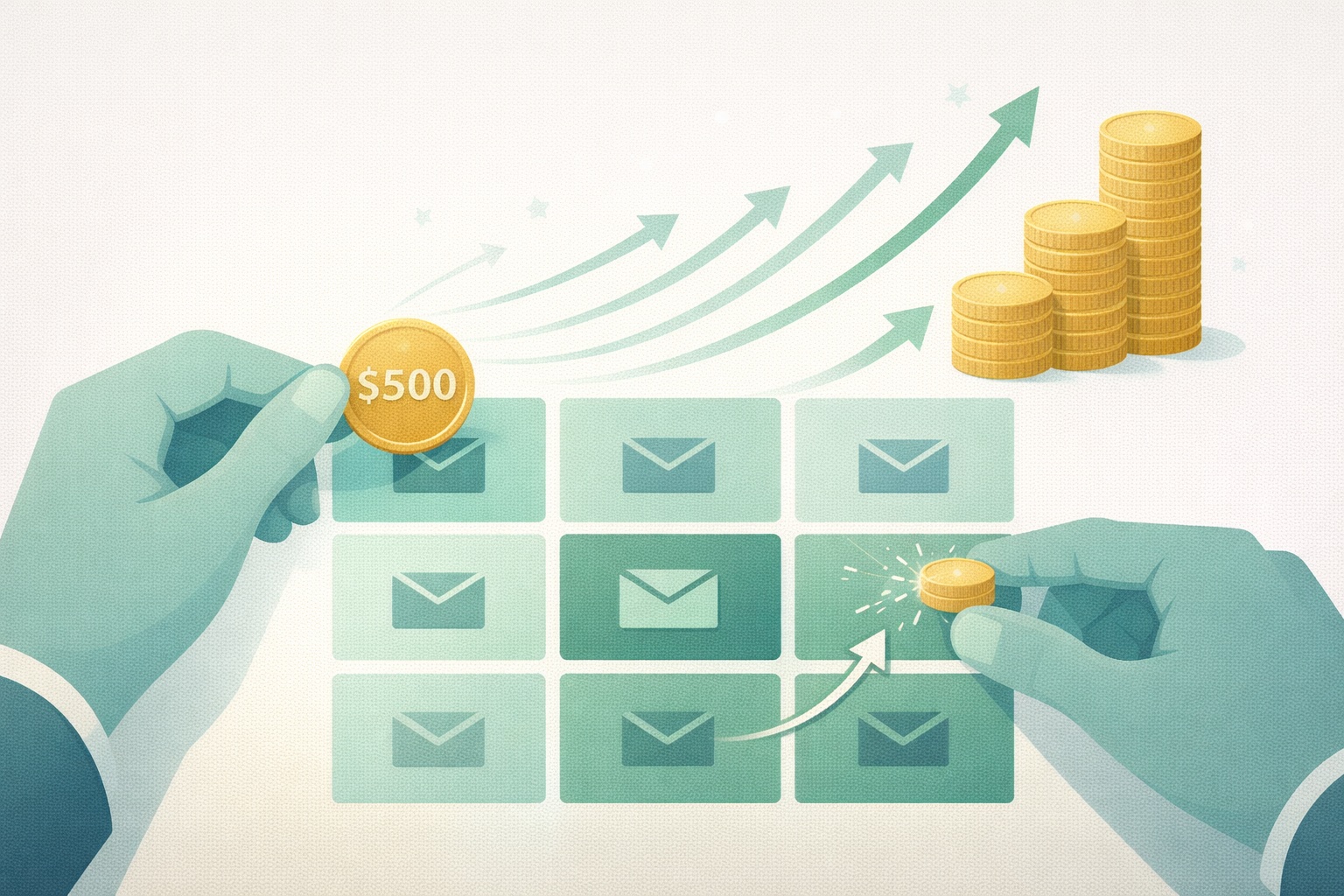
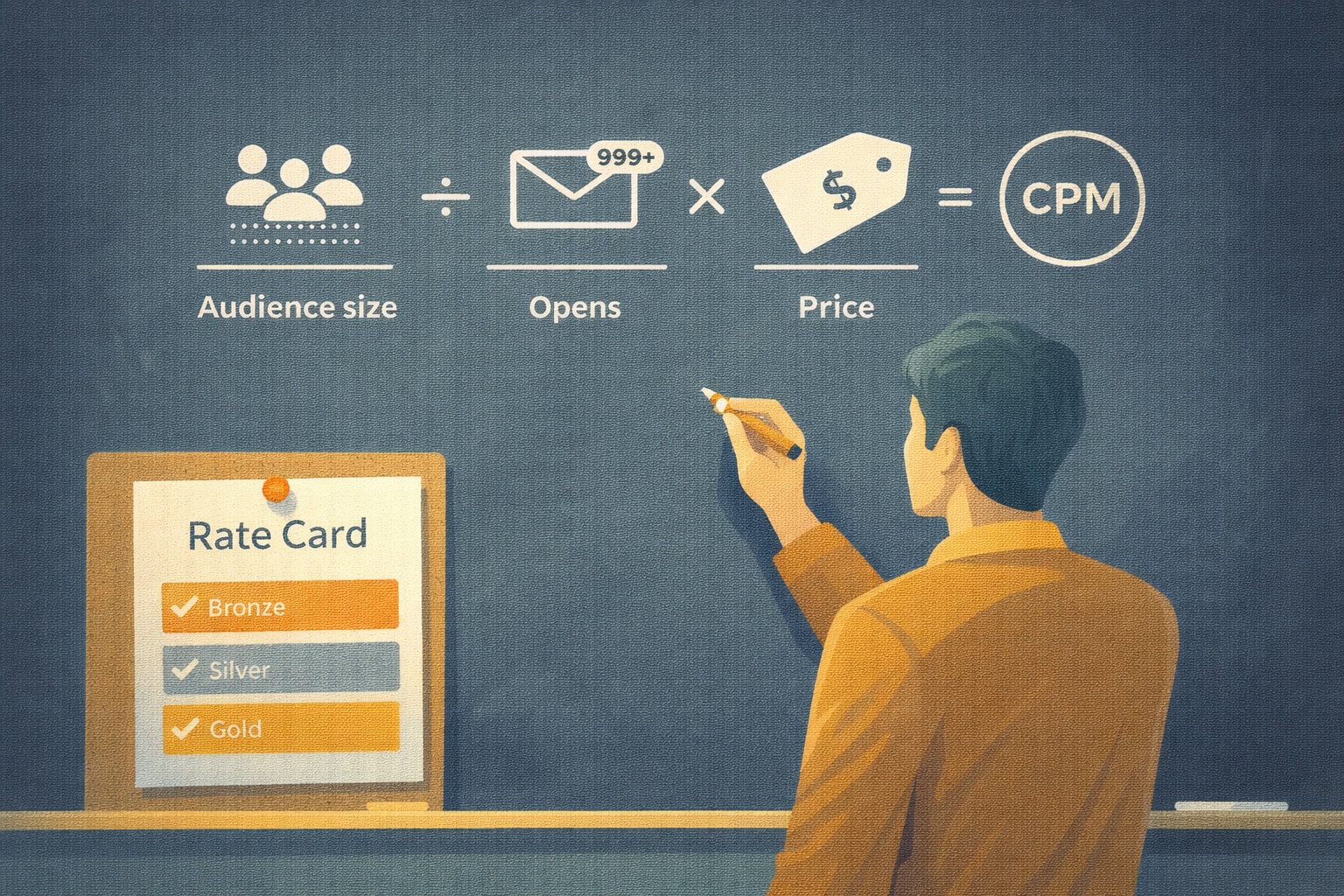
CPM stands for cost per mille — Latin for thousand. In newsletter advertising, it represents the price an advertiser pays for every one thousand times their ad is displayed. If you charge $500 for a placement in a newsletter that delivers 10,000 impressions, your CPM is $50. If you charge $300 for a placement that delivers 5,000 impressions, your CPM is also $60. The formula is always the same: divide the flat rate by the number of impressions delivered, then multiply by one thousand.
In email, impressions are typically counted as opens, not sends. A list of 20,000 subscribers with a 40 percent open rate delivers 8,000 impressions per issue. That number — not the subscriber count — is what advertisers actually see. Publishers who quote rates based on subscriber count without clarifying open rates create expectations that underperform in practice, which damages trust and reduces repeat bookings. Always base your CPM on average unique opens across the last eight to twelve issues. This is your true deliverable.
Understanding the distinction between subscribers and impressions also protects you commercially. A newsletter with 10,000 subscribers and a 55 percent open rate delivers 5,500 impressions. A newsletter with 40,000 subscribers and a 15 percent open rate delivers 6,000 impressions. The two lists are roughly equivalent in reach but radically different in quality. The smaller, higher-engagement list commands a higher CPM because its readers are demonstrably more attentive — and attentive readers convert at higher rates for advertisers.
The CPM pricing formula: How to calculate your baseline rate
Your baseline CPM is the floor below which you should not sell. It represents the minimum rate at which advertising revenue makes operational sense, accounting for your cost to produce the newsletter and the opportunity cost of a sponsored slot. To calculate it, start with three inputs: your average unique opens per issue, your target monthly ad revenue, and the number of ad slots you plan to sell per issue.
Here is how the formula works in practice. Suppose your newsletter sends weekly — four issues per month — and averages 8,000 unique opens per issue. You have two ad slots per issue: a premium top placement and a secondary mid-content placement. Your target is $2,000 per month from advertising. That means you need to generate $500 per issue across two slots — roughly $350 for the top slot and $150 for the secondary. Divide each by the deliverable impressions: $350 divided by 8 (thousands) equals a $43.75 CPM for the top slot. $150 divided by 8 equals an $18.75 CPM for the secondary. Round these to clean numbers — $45 and $20 — and you have a baseline rate card built from your actual economics, not someone else's.
This calculation assumes 100 percent fill rate, which is unrealistic for direct-sold inventory. If you expect to sell 70 percent of your premium slots and 50 percent of your secondary slots each month, adjust your rates upward to compensate. A 70 percent fill rate on the premium slot means you need each sold slot to generate approximately $500 to hit your monthly target, which pushes your effective CPM to $62.50 at 8,000 opens. For programmatic inventory — where fill rate can approach 100 percent through automated demand — floors can be set lower because volume compensates for margin. The math should always begin with your target revenue and work backward to the rate, not the other way around.
The five variables that determine where your CPM should sit
Once you have a baseline, five variables determine whether your rates should sit above or below the market average. Understanding each one gives you the language to justify your pricing to advertisers and the knowledge to increase rates as your newsletter matures.
The first variable is niche specificity. Newsletters that serve a defined, hard-to-reach audience command premium CPMs because advertisers cannot easily find that concentration of attention elsewhere. A newsletter about fintech for CFOs at mid-market companies is worth significantly more per impression than a general business newsletter, even if the CFO newsletter has a smaller list. Advertiser demand for access to a specific professional identity drives CPM up. Niche newsletters in finance, legal, medical, developer, and executive verticals regularly command CPMs of $80 to $150 or more. General-interest newsletters with broad demographics typically fall in the $15 to $40 range.
The second variable is open rate relative to category norms. An open rate above 40 percent is strong across most categories. Above 50 percent is exceptional and justifies a premium. Below 25 percent signals list quality issues that will suppress advertiser results and make CPM increases difficult to defend. Our guide on open rate optimization covers the tactics that move this number. If your open rate exceeds the category average by 10 or more percentage points, you can price 15 to 25 percent above the category midpoint. If it lags the average, your pricing should reflect that gap until the metric improves.
The third variable is placement position. Top-of-newsletter placements — appearing before the first editorial section — see the highest visibility and command the highest CPMs, typically 30 to 50 percent above secondary placements. Mid-content placements, embedded within editorial, perform well because they benefit from reader momentum but command slightly less because they compete with surrounding content. Footer placements are the weakest performers and should be priced accordingly — or reserved for programmatic fill to avoid discounting premium inventory.
The fourth variable is audience demographics and buyer intent. An audience that skews toward decision-makers, high earners, or professionals with active purchasing authority is worth more per impression than a general consumer audience. If your subscribers are predominantly people who actively read about a topic because they are solving a professional problem — not just casually curious — that intent translates into higher conversion rates for advertisers, which justifies higher CPMs. If you have survey data, LinkedIn demographic insights, or subscriber intake form responses that profile your audience, use them to build the case for premium pricing.
The fifth variable is list growth trajectory. A newsletter that is adding 1,000 subscribers per month on a list of 15,000 is telling advertisers that the audience will be larger by the time the campaign runs. Growing lists command a forward premium because advertisers who book early lock in a rate that will deliver increasing value over subsequent issues. A newsletter in decline — even if currently large — faces the opposite dynamic; savvy advertisers will push for rate concessions that reflect the deteriorating trajectory.
Industry CPM benchmarks by category: Where does your newsletter fit?
Knowing the market ranges for your category is essential before finalizing your rate card. Charging $25 CPM for a fintech newsletter leaves money on the table. Charging $120 CPM for a general lifestyle newsletter will drive advertisers away. Anchoring to category norms gives you a starting point from which your specific metrics — open rate, niche specificity, audience demographics — adjust the final number up or down.
Finance and investing newsletters — including personal finance, trading, and institutional finance — command CPMs of $60 to $150. The audience actively manages money and makes decisions with significant financial consequences, which makes advertiser ROI achievable at premium rates. B2B SaaS and technology newsletters targeting developers, engineering leaders, or product managers command $50 to $120. These audiences have purchasing authority and evaluate tools on a regular basis. Marketing and growth newsletters command $40 to $80 because the audience understands advertising and responds to well-crafted offers in their professional domain.
Health and wellness newsletters — encompassing fitness, nutrition, and mental health — command $30 to $70, depending on whether the audience is general consumers or healthcare professionals. A newsletter for general fitness enthusiasts sits toward the lower end; a newsletter for registered dietitians or physical therapists commands the upper range because of professional specificity. E-commerce and retail newsletters serving general consumers typically range from $15 to $40 CPM. The audience is broad, intent varies widely, and advertiser competition drives prices lower than professional verticals.
General-interest newsletters — news digests, lifestyle content, pop culture — sit in the $10 to $30 range. These newsletters compete primarily on volume and efficiency rather than audience specificity. They can generate strong total revenue through programmatic channels that aggregate demand across many impressions, but their per-impression value is lower than niche alternatives. If your newsletter falls into this category, the path to higher revenue runs through either increasing list size significantly or narrowing editorial focus to build a more defensible audience identity.
Building a tiered rate card: How to structure your pricing for different advertisers
A single flat rate for all placements is a missed opportunity. Publishers who build tiered rate cards — with distinct pricing for different placement types, booking windows, and volume commitments — capture more revenue from advertisers who value certainty and integration, while still offering accessible entry points for first-time buyers testing the channel.
The standard tier structure has three levels. The premium tier covers the top placement — the first ad unit a reader sees — and commands your highest CPM. It should include exclusive placement in that position for the issue, meaning no other advertiser appears at the top. This exclusivity is itself a value proposition. The premium tier pricing should reflect your category CPM upper range. For a fintech newsletter with 10,000 average opens and strong engagement, this might be $80 CPM, translating to an $800 flat rate per issue.
The standard tier covers mid-content placements. These are embedded within editorial sections, benefit from reader momentum, and typically deliver click-through rates that are 20 to 30 percent lower than top placements but still meaningful. Price these at 50 to 65 percent of your premium rate. Using the same example, a $50 to $55 CPM — translating to $500 to $550 per issue — is appropriate. This tier attracts advertisers who want newsletter presence without paying top-of-mind rates, and it allows you to fill more slots per issue without discounting premium inventory.
The value tier covers footer placements or secondary newsletter sections. These are the lowest-visibility positions but still reach readers who engage with the full issue. Price these at 25 to 35 percent of your premium rate. In the same example, $25 to $30 CPM — translating to $250 to $300 per issue — makes sense. This tier is also where programmatic demand should fill unsold slots rather than leaving inventory empty. An empty slot generates zero revenue; a programmatic fill at $20 CPM generates incremental income without disrupting your direct-sold tiers.
Beyond placement tiers, consider volume discounts for multi-issue commitments. An advertiser booking a single issue pays your standard rate. An advertiser committing to four consecutive issues should receive a five percent discount. An advertiser booking a quarterly run of twelve issues should receive a ten to fifteen percent discount. These discounts are worthwhile because committed bookings reduce the cost of re-selling inventory each issue, give you predictable revenue, and build advertiser relationships that generate repeat business and referrals.
Setting programmatic price floors: Protecting your premium without leaving revenue behind
Programmatic advertising in newsletters fills unsold inventory automatically through real-time bidding. The critical control in programmatic is the price floor — the minimum CPM you will accept from any programmatic buyer. Setting this number correctly protects your premium direct-sold rates while capturing revenue from inventory that would otherwise go dark.
The principle behind floor setting is simple: your programmatic floor should never undercut your direct-sold rates for equivalent placements. If you charge $80 CPM for a direct premium top placement, setting a programmatic floor of $20 for that same position would let programmatic buyers access your best inventory for a fraction of what direct buyers pay. This discrepancy will eventually cause direct buyers to question why they are paying a premium when they can access similar inventory more cheaply through programmatic channels.
For premium placements, set programmatic floors at 40 to 60 percent of your direct CPM. For a $80 direct CPM, a $35 to $45 programmatic floor is appropriate. This ensures that only bids representing genuine demand — advertisers who value your specific audience — clear the auction. Bids below the floor are rejected, leaving the slot unfilled rather than filled at a rate that undermines your rate card. For secondary and footer placements, floors can sit lower — 20 to 30 percent of your direct CPM — because these positions are not competing directly with premium inventory and volume of fill matters more than per-impression margin.
Review your programmatic floors every 30 to 60 days. If fill rates are consistently above 80 percent at your current floor, the market is telling you that demand exceeds supply at that price — you can raise the floor by 10 to 15 percent and capture more revenue per impression. If fill rates fall below 40 percent, the floor may be set too high for current demand; reducing it by 10 percent will increase fills and total revenue even if per-impression yield drops slightly. This iterative approach optimizes yield over time without requiring you to guess the right number upfront.
How to present your rates: The media kit pricing section
How you present your rates is almost as important as what they are. Advertisers evaluate many newsletters when planning campaigns, and the clarity and confidence of your media kit pricing section signals your professionalism and the seriousness of your operation. Vague rates — "pricing varies, contact us" — create friction. Rates that are presented without audience context create skepticism. A well-constructed pricing section gives advertisers everything they need to make a decision without a conversation.
Your pricing section should display rates by placement tier, with the corresponding CPM, flat rate per issue, and what is included in each tier. Include the average unique opens you use to calculate rates, the open rate percentage, and the list size for context. If you have third-party verification from your email service provider — a screenshot or export of your performance dashboard — include it or offer it on request. Verified data builds trust faster than any copywriting.
State your booking lead time and payment terms clearly. Most newsletter publishers require payment upfront or within seven days of booking confirmation. Invoicing net-30 or net-60 creates cash flow problems and gives low-quality advertisers an easy exit. Collecting payment before the campaign runs protects you and signals that you treat this as a professional commercial operation. Include your ad specifications — file formats, character limits, image dimensions — so advertisers can prepare materials without a back-and-forth.
If you have case studies or performance data from previous campaigns — click-through rates, conversion outcomes, testimonials from advertisers — include them adjacent to the pricing section. Social proof from past buyers is the most effective tool for converting prospects who are on the fence about a first booking. A simple line like "Advertiser X achieved 3.2 percent CTR and 14 percent conversion on their landing page from a single issue placement" does more for your rate justification than any amount of copywriting about audience quality.
When and how to raise your rates
Rates should not be static. As your newsletter grows, your engagement improves, and advertiser demand increases, your pricing should reflect that. The question is not whether to raise rates but when and by how much. Raising rates too aggressively too fast drives away early advertisers who built their expectations on your original pricing. Raising them too slowly means leaving revenue behind and making it harder to ever correct the gap.
The clearest trigger for a rate increase is consistent demand. If your premium slot is booked more than eight weeks out on a regular basis, you have a scarcity signal. Advertisers are competing for access, which means they would pay more if required. In this situation, a 15 to 25 percent rate increase at your next rate card review is defensible and unlikely to cost you more than one or two bookings from price-sensitive buyers. The revenue impact of a 20 percent rate increase far outweighs the cost of losing one booking per quarter.
The second trigger is audience growth. If your average opens have increased by 30 percent or more since you last set your rates, your CPM is effectively delivering 30 percent more value at the old price. An open rate improvement — from 35 percent to 48 percent, for example — has the same effect. Both justify a rate recalibration that keeps your CPM constant but increases the flat rate per issue, or increases the CPM itself if market comparables support it.
Communicate rate increases to existing advertisers before they take effect. Give them at least 30 days notice and offer them a chance to lock in the old rate for a multi-issue commitment made before the change. This practice rewards loyalty, converts undecided repeat buyers into committed ones, and reduces the friction of the transition. Advertisers who feel treated fairly through a rate change are more likely to continue the relationship than those who encounter a price increase without warning.
Common pricing mistakes publishers make — and how to avoid them
The most damaging pricing mistake is undervaluing niche audiences. Publishers who have built highly specific, high-intent readerships often set rates based on list size rather than audience quality, leaving a significant premium unclaimed. A newsletter with 5,000 readers in the cybersecurity space should charge more than a newsletter with 50,000 readers covering general tech news, because the cybersecurity audience is harder to reach, more professionally aligned, and more valuable to relevant advertisers. If you have a niche audience, price like it.
The second mistake is discounting to close deals. Publishers who drop rates whenever an advertiser pushes back signal that their stated rate is fictional. This trains buyers to always negotiate, undermines your rate card credibility, and attracts deal-hunters rather than long-term partners. If an advertiser cannot afford your rates, offer them a smaller placement — not a discount on your premium slot. Maintaining rate integrity is more valuable than filling every slot at any price.
The third mistake is ignoring unfilled inventory cost. An empty slot in your newsletter is not neutral — it represents revenue that expired. Publishers who refuse programmatic out of concern that it will cheapen their brand often lose more from unsold inventory than they would give up in perceived quality. A well-configured programmatic floor — set above the rate at which discounting becomes harmful — captures revenue from inventory that would otherwise generate nothing. Platforms like InboxBanner allow publishers to set floors, approve ad categories, and maintain editorial standards while still capturing programmatic demand.
The fourth mistake is setting rates annually and never revisiting them. A rate card built when your newsletter had 3,000 subscribers should not still be in use at 15,000. Stale pricing is a form of self-underpayment. Schedule a rate card review every quarter — even if the outcome is no change — to ensure your pricing reflects your current audience size, engagement quality, and market position.
A practical pricing example: Rate card for a 12,000-subscriber newsletter
To make the framework concrete, here is how a publisher with a 12,000-subscriber newsletter in the marketing vertical — averaging 48 percent open rate, delivering approximately 5,760 unique opens per issue, sending weekly — might build their rate card.
The category midpoint CPM for marketing newsletters is approximately $50 to $60. At a 48 percent open rate — significantly above the category average of 35 percent — this publisher is justified in pricing at the upper end of the range. The premium top placement at $65 CPM on 5,760 opens translates to a flat rate of $374 per issue, rounded to $375. The standard mid-content placement at $40 CPM translates to $230 per issue, rounded to $225. The footer placement at $20 CPM translates to $115 per issue, rounded to $110. Total per-issue revenue at full fill is $710.
At four issues per month, full fill would generate $2,840. Assuming a realistic 75 percent fill rate on premium, 60 percent on standard, and 80 percent fill through programmatic on footer placements, the expected monthly revenue is approximately $1,900 to $2,100 — a meaningful income that grows as audience and demand increase. The programmatic floor for the footer at $15 CPM ensures that unsold direct slots never go dark. As the newsletter grows toward 20,000 opens per issue, the same rate card delivers proportionally higher revenue without requiring a rate renegotiation.
This example demonstrates why the formula matters more than the specific numbers. The inputs — your open rate, your category CPM, your target revenue — will differ from this example. But the structure of the calculation remains the same regardless of list size or vertical. Start with what the market pays for audiences like yours. Adjust for your specific engagement quality. Divide by your deliverable impressions. Round to clean, quotable numbers. Protect your premium tiers from programmatic undercutting with appropriate floors. And revisit the whole model every quarter.
Conclusion: Price with confidence, not apology
Newsletter ad pricing is one of the most consequential decisions a publisher makes, and it is one of the most consistently underdeveloped. Publishers who treat pricing as a formula — grounded in audience quality, market comparables, and clear economics — command better rates, attract better advertisers, and build more durable revenue than those who guess or defer to whatever the market seems to offer at first inquiry.
The framework in this guide gives you everything you need to set rates you can defend. You know your baseline CPM from your audience size and target revenue. You know where your specific variables — niche, open rate, placement, demographics, growth — push that number up or down. You know how to build a rate card with tiers that serve different advertiser budgets without discounting your premium inventory. And you know how to use programmatic floors to capture revenue from unsold inventory without undermining your direct rates.
The only thing left is to put the rate card into practice and hold it with discipline. Advertisers respect publishers who know what their audience is worth and price accordingly. That confidence — more than any tactic, format, or platform — is what separates newsletters that monetize well from those that perpetually undercharge.