Introduction: One list, many audiences — why segmentation unlocks revenue
Every newsletter publisher sends to "their list" as though it were a single, uniform audience. In practice, no list is uniform. A marketing newsletter with 15,000 subscribers contains agency owners and in-house marketers, SEO specialists and paid acquisition managers, early-career professionals and CMOs with seven-figure budgets. These people share a subscription but not a context, not a job to be done, and not a purchasing authority. Sending them identical content and identical advertising is the most common source of preventable revenue loss in newsletter publishing.
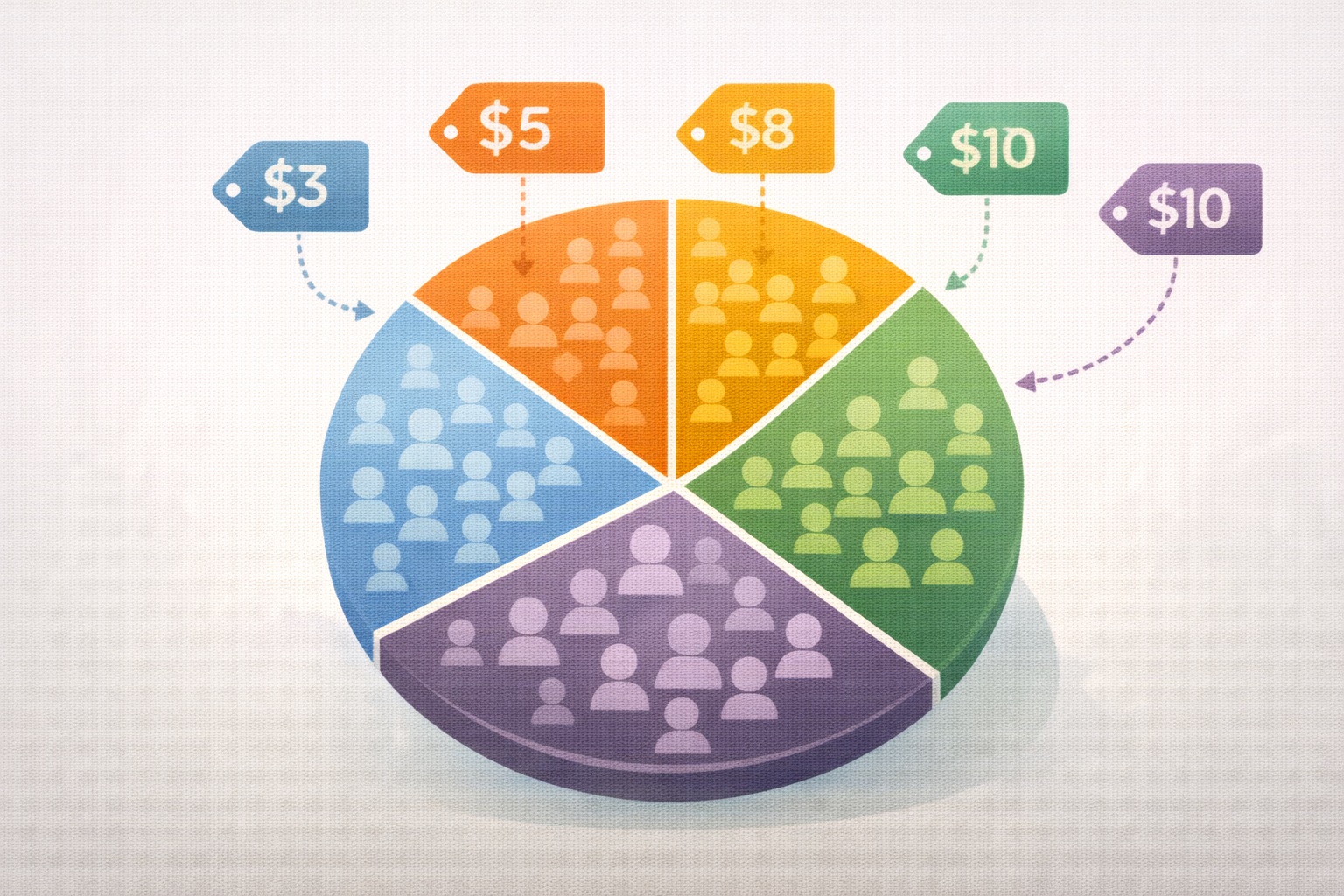
Audience segmentation is the practice of dividing your subscriber list into groups based on shared characteristics — behavioral, demographic, professional, or preferential — and using those groups to deliver more relevant content, more targeted advertising, and more defensible CPM pricing. Done well, segmentation transforms a single list into a portfolio of audiences, each of which has distinct commercial value to a different category of advertiser. A publisher who can offer an advertiser access to "the 3,200 subscribers who have clicked on SaaS tool reviews in the last 90 days" is selling something meaningfully different from access to "15,000 marketing professionals."
This guide covers the mechanics of newsletter audience segmentation from a revenue perspective: the data signals that make segmentation possible, the segmentation models that work in practice, how to use segments to command higher CPMs, how to present segmented inventory to advertisers, and how to build a segmentation system that becomes more valuable over time without requiring a dedicated data team to maintain it.
Why segmentation directly increases ad revenue: The commercial logic
Before examining how to segment, it is worth being precise about why segmentation increases ad revenue. The mechanism is not simply that smaller, more targeted audiences are inherently more valuable — it is that targeting precision reduces advertiser risk, and reduced risk commands a price premium. An advertiser buying a placement in a general newsletter of 15,000 subscribers is accepting significant uncertainty about how many of those subscribers match their customer profile. An advertiser buying a placement that reaches the 2,800 subscribers who have demonstrated interest in their specific product category has reduced that uncertainty substantially. That reduction in uncertainty is worth paying for — and the CPM premium for targeted inventory in newsletter advertising reflects exactly that.
The second mechanism is fill rate improvement. A newsletter that offers only a single, unsegmented inventory unit attracts only advertisers whose product is a fit for the full list. A newsletter that offers three or four distinct audience segments attracts advertisers whose product fits each specific segment — multiplying the number of potential buyers for any given issue. Higher demand for finite inventory drives prices up. Publishers who have built segmented inventory consistently report that they can fill more ad slots at higher CPMs than publishers offering equivalent total reach without segmentation because they are serving a broader range of advertiser needs from the same subscriber base.
The third mechanism is advertiser retention. Advertisers who buy segmented placements and see strong performance — because the audience was specifically matched to their product — renew at higher rates than those who buy general placements and see average results. The segment match reduces the creative and messaging work required to achieve a good CTR, which makes the advertiser's experience easier and their results better. Better results produce repeat bookings. Repeat bookings produce referrals. The compounding effect of higher advertiser retention on revenue is significant over a twelve-month period.
The four types of segmentation data — and how to collect each
Audience segmentation requires data about your subscribers. The quality of your segments is a direct function of the quality of the data you have collected — which means that building a segmentation capability is partly a data collection project and partly a data activation project. There are four types of segmentation data available to newsletter publishers, each with different collection mechanisms, different strengths, and different applications.
The first type is behavioral data — what subscribers have actually done with your newsletter. Which links they clicked, which topics generated the most engagement, how frequently they open, whether they forward issues, whether they reply. Behavioral data is the most valuable segmentation signal because it reflects revealed preference rather than stated preference. A subscriber who clicks on every link related to email deliverability, regardless of whether they described themselves as an email marketer at signup, is demonstrating a specific interest that behavioral data captures and declared data misses. Most email service providers collect behavioral data automatically; the publisher's task is to tag and segment based on that data rather than ignoring it.
The second type is declared data — information subscribers have explicitly provided, typically at signup or through a survey. Job title, industry, company size, geographic location, years of experience, current tools used, primary challenge they are trying to solve. Declared data is easy to collect and straightforward to segment by, but it has two limitations: it represents the subscriber at the moment of signup rather than their current situation, and it is only as accurate as the subscriber's willingness to fill in a form carefully. A subscriber survey sent to your existing list at regular intervals — every six to twelve months — keeps declared data current and gives you the opportunity to collect additional detail as the relationship with the subscriber deepens.
The third type is inferred data — characteristics derived from combining behavioral and declared signals rather than observing them directly. A subscriber who works at a company in a specific industry, clicks primarily on tactical implementation content, and opens within the first hour of every send is demonstrating an interest profile that can be inferred even without explicitly asking "are you a hands-on practitioner looking for implementation guidance?" Inferred segments are typically more predictive than either behavioral or declared data alone because they combine the specificity of declared identity with the reliability of demonstrated behavior.
The fourth type is transactional data — information about past interactions with your newsletter's commercial layer, including which ads subscribers have clicked, which products they have purchased through affiliate links, and whether they have responded to promotional content in previous issues. Transactional data is the most directly commercial segmentation signal: a subscriber who has clicked on two previous SaaS tool advertisements and one productivity book affiliate link is demonstrating commercial intent in a specific category that an advertiser in that category would pay a meaningful premium to reach. Not all publishers have built the infrastructure to collect transactional data at this level, but those who have find it produces the highest CPM premiums of any segmentation type.
Five segmentation models that work in newsletter publishing
With data in hand, the next question is how to group subscribers into segments that are commercially useful — specific enough to be valuable to advertisers but large enough to deliver meaningful reach. There is no single correct segmentation model; the right approach depends on the nature of your newsletter, the diversity of your audience, and the categories of advertisers you are targeting. Five models work reliably in newsletter publishing contexts.
The engagement-based model divides subscribers into tiers based on how actively they engage with the newsletter. A common tier structure has three levels: highly engaged subscribers who open more than 70 percent of issues and click regularly; moderately engaged subscribers who open 30 to 70 percent of issues but click less frequently; and low-engagement subscribers who open fewer than 30 percent of issues. The highly engaged tier commands the highest CPM because it represents the subscribers most likely to see and act on an ad. For publishers who want to offer a premium inventory product without building a complex segmentation infrastructure, the engagement tier model is the simplest high-value starting point.
The topic-affinity model groups subscribers based on the content categories they engage with most. A newsletter covering multiple topics — marketing, sales, and operations, for example — can segment subscribers who primarily click on marketing content, those who primarily engage with sales content, and those who engage broadly across all topics. Each segment becomes a distinct inventory product for advertisers in the corresponding category. A sales tool company can buy access to the sales affinity segment rather than paying for impressions against the marketing and operations subscribers who are not their target customer.
The professional profile model segments subscribers by declared job function, industry, seniority, or company size. This model is most powerful for B2B newsletters where the professional identity of the subscriber is the primary determinant of advertiser fit. A newsletter whose subscribers include both individual contributors and senior decision-makers can price placement against the decision-maker segment at a premium, because that segment represents buying authority that individual contributors — however engaged — do not have. Professional profile segmentation requires declared data, which means it depends on having a subscriber survey or a detailed signup flow that collects professional information.
The geographic model segments subscribers by location — country, region, or city. Geographic segmentation is most valuable for advertisers with local or regional offerings: a recruiting firm that only hires in specific markets, a events company with city-specific programming, a retailer with physical locations in certain regions. Publishers in niches with significant geographic concentration — a local business newsletter, a region-specific industry publication — can command meaningful premiums for geographic segments even at smaller absolute sizes than the full list.
The lifecycle model segments subscribers by their stage in the subscriber relationship. New subscribers in their first 30 days are in a distinct engagement phase from established subscribers of 12 or more months. Returning subscribers who re-engaged after a dormant period represent a different audience signal from subscribers who have never churned. For advertisers offering products aimed at people new to a category — onboarding tools, beginner resources, entry-level products — the new subscriber segment is specifically valuable. For advertisers whose products serve established practitioners — advanced tools, premium services, high-commitment offers — the long-tenure subscriber segment is the target. Lifecycle segmentation creates inventory that matches advertiser stage-of-buyer targeting without requiring any additional demographic data collection.
How to implement segmentation in your email service provider
Segmentation is only as useful as your ability to activate it — to actually send targeted content or targeted ads to specific subscriber groups rather than to the full list. The technical implementation of segmentation varies by email service provider, but the core mechanics are consistent: tags or custom fields that store segment attributes, list segments or groups defined by those attributes, and the ability to filter sends or ad placements by segment at send time.
Most modern email service providers — ConvertKit, Mailchimp, Beehiiv, ActiveCampaign, and others — support tag-based segmentation natively. Tags are labels attached to individual subscribers that can be applied automatically based on behavior — a click on a specific link type triggers a tag — or manually based on declared data collected at signup. The first step in implementing segmentation is defining the tags that correspond to your chosen segmentation model, then configuring your email service provider to apply those tags based on the appropriate triggers.
For behavioral segmentation, configure link click automations: when a subscriber clicks any link in the "tools" category, apply the "tools-interest" tag. When a subscriber opens five consecutive issues, apply the "highly-engaged" tag. When a subscriber has not opened in 60 days, apply the "at-risk" tag. These automations run silently in the background, continuously updating subscriber segments as behavior changes. A subscriber who was low-engagement six months ago and has since opened every issue moves from the low-engagement segment to the highly-engaged segment automatically, without any manual intervention.
For declared data segmentation, configure your signup form to collect the fields you need — job title, industry, company size — and map those fields to tags or custom fields in your email service provider. For existing subscribers who have not provided this information, a targeted survey email with a three-to-five question form, sent with a compelling subject line and a small incentive for completion, will collect professional data from 15 to 25 percent of your active list — enough to build meaningful professional profile segments even without 100 percent coverage.
Once tags are in place, create saved segments that combine multiple tag criteria. A "premium advertiser target" segment might require: highly-engaged tag AND marketing-professional tag AND company-size-50-plus tag. This combined segment identifies the subscribers who are both most likely to engage with an ad and most likely to match a B2B advertiser's buyer profile — a far more precise inventory product than any single-dimension segment.
Presenting segmented inventory to advertisers — how to sell what you've built
Building segments is the infrastructure investment. Selling them is the commercial return. Most publishers who have built segmentation capability undersell it to advertisers because they present it as a technical feature rather than a commercial benefit. The correct framing is not "we have audience segments" — it is "we can reach the specific subscribers in our audience who match your buyer profile, rather than the full list."
In your media kit, present segmented inventory as distinct products alongside your standard full-list placements. Each segment should have its own description — "the 2,400 subscribers who have engaged with content about marketing analytics in the last 90 days" — its own size, its own open rate benchmark, and its own rate. The rate for a targeted segment should be higher per impression than the full-list rate because the targeting precision reduces advertiser risk. A reasonable premium for a well-defined behavioral or professional segment is 20 to 40 percent above the equivalent full-list CPM — use our CPM pricing formula to set the baseline before calculating the segment premium. Advertisers in categories where audience specificity has historically been difficult to achieve — B2B decision-maker targeting, technical professional audiences, high-income consumer niches — will accept premiums at the upper end of this range.
When discussing segments with advertisers, lead with the audience description rather than the technical mechanism. "We can reach the subscribers in our list who are actively evaluating marketing analytics tools — roughly 2,400 people who have clicked on related content in the last quarter" is a commercial pitch. "We have behavioral segmentation based on click data" is a feature description. The former tells the advertiser what they are buying in terms of expected outcomes. The latter tells them how you built the product. Outcomes sell; features do not.
For advertisers who are new to newsletter advertising or skeptical of segment quality, offer a side-by-side test: one placement against the full list and one against the relevant segment in the same issue or adjacent issues. The performance comparison will almost always demonstrate the value of the targeted placement, because the segment's higher relevance produces a higher CTR at the same or smaller impression volume. This test converts segment skeptics into segment buyers and generates the case study data that makes future segment sales easier.
Segmentation and programmatic advertising — how platforms use your audience data
Segmentation is not only a tool for direct sponsorship sales. Programmatic advertising platforms use audience signals to match relevant demand to your inventory automatically, and the quality and richness of your audience data directly affects the CPMs you receive from programmatic buyers. Publishers who have built detailed first-party audience segments and who make those signals available to programmatic platforms command higher floors and see higher fill rates than publishers with undifferentiated inventory.
Platforms like InboxBanner use contextual and behavioral signals from your newsletter to match advertisers to impressions in real time. The more your audience has demonstrated specific interests through their engagement behavior, the more precisely the platform can match their impressions to advertisers willing to pay a premium to reach them. A subscriber who has clicked on three consecutive fintech-related links in your newsletter is a more valuable programmatic impression for a fintech advertiser than a subscriber with no demonstrated interest pattern — and the platform's auction mechanism rewards that specificity with a higher winning bid.
For publishers using programmatic to fill unsold inventory, segmentation also allows you to set differentiated price floors by audience quality. Your highly-engaged segment might carry a programmatic floor of $45 CPM. Your general list floor might sit at $20 CPM. These differentiated floors ensure that your most valuable audience segments — the ones that produce the highest advertiser returns — are never filled at the same rate as your general inventory, even through automated channels. Without segmentation, a single floor applies across all impressions, which means either your premium audience is underpriced or your general audience is priced out of fill.
Content segmentation: Sending the right issue to the right subscribers
Audience segmentation is most commonly discussed in the context of advertising, but its impact on content relevance — and therefore on the open rates and engagement that justify premium ad rates — is equally significant. A publisher who sends topic-specific deep dives to the subscribers most likely to value them, rather than to the full list, increases the relevance of every send for every subscriber. Higher relevance produces higher open rates, lower churn, and the engagement metrics that make ad inventory more valuable to purchase.
Content segmentation does not require producing entirely separate newsletters for each segment. The most practical approach for most publishers is a core newsletter that every subscriber receives, with one or two additional content sections that are conditionally included for specific segments. A marketing newsletter might send a standard issue to its full list and include an additional SEO deep-dive section only for subscribers tagged with SEO interest. The production overhead is one additional content section per issue; the relevance improvement for the SEO-interested segment is significant.
Over time, content segmentation data becomes a virtuous cycle. Subscribers who receive more relevant content engage more frequently. Higher engagement generates richer behavioral data. Richer behavioral data produces more accurate segments. More accurate segments enable more relevant content targeting. Publishers who begin this cycle early — even with simple, two-segment content personalization — find that their audience data quality improves substantially over twelve to eighteen months, which compounds into both higher engagement metrics and higher ad revenue from the more precise inventory that better data enables.
Measuring the revenue impact of segmentation — what to track
Segmentation is an investment of time and operational complexity. Measuring its return requires tracking metrics that connect audience data quality to commercial outcomes — not just measuring open rates and CTRs, which improve for reasons unrelated to segmentation, but measuring the specific revenue effects attributable to the segments you have built.
The primary metric is CPM by segment versus CPM for general inventory. If your segmented placements are commanding a 30 percent premium over your full-list placements, and 40 percent of your ad inventory is sold as segmented, you can calculate the incremental revenue attributable directly to segmentation. Track this quarterly to measure whether the premium is growing — which it should as your segment data becomes richer and your case study evidence for segment performance accumulates — or whether it has plateaued, which signals that you need to develop new segments or improve the quality of existing ones.
The secondary metric is advertiser repeat booking rate by placement type. Advertisers who bought segmented placements should renew at higher rates than those who bought general inventory, because segmented placements produce better outcomes. If you do not see this pattern — if segment buyers renew at the same rate or lower than general buyers — investigate whether your segments are being accurately matched to advertiser needs or whether the segment descriptions in your outreach are creating mismatched expectations that underperform.
The tertiary metric is overall list engagement quality over time. As segmentation enables more relevant content, your aggregate open rate and click-through rate should improve. This improvement compounds into higher CPM justification for all inventory — not just segmented placements — because advertisers evaluating your newsletter see better engagement metrics across the board. Track your rolling average open rate and CTR quarterly and correlate trends with segmentation implementation milestones to build the evidence that segmentation is improving your core metrics, not just your targeted inventory pricing.
Building your segmentation roadmap: Where to start and how to scale
Segmentation is a capability that builds over time rather than a project with a single completion point. Publishers who approach it as a long-term investment — starting simple, measuring outcomes, and adding complexity incrementally — consistently outperform those who attempt to build a sophisticated segmentation architecture before they have the audience data to support it. The roadmap has three natural phases.
Phase one — which any publisher can begin with their next issue — is engagement-tier segmentation. Configure your email service provider to tag subscribers as highly engaged, moderately engaged, or low-engagement based on their open and click behavior over the last 60 days. Create a premium ad placement product targeted to the highly-engaged tier and price it at a 20 to 25 percent premium over your standard rate. Promote this product to two or three of your current or prospective advertisers as a test. This phase requires no new data collection, no subscriber surveys, and no changes to your newsletter format — only the activation of behavioral data your email service provider is already collecting.
Phase two — typically three to six months into the segmentation program — is topic-affinity segmentation. By this point, you have accumulated enough click data to identify the content categories your subscribers engage with most. Create segments based on the two or three topic areas that generate the most clicks, tag subscribers accordingly, and add topic-segment ad products to your media kit. Send a brief subscriber survey to fill gaps in behavioral data with declared preferences. Use the survey data to validate and refine your behavioral segments — do subscribers who click on certain topics also declare related professional interests? If so, the combined segment is stronger than either signal alone.
Phase three — at twelve or more months — is professional profile and transactional segmentation. By this stage, you have collected enough declared data through surveys and signup forms, and enough transactional data through affiliate clicks and ad engagement history, to build the most commercially valuable segments: professional decision-maker segments that command the highest B2B advertiser premiums, and purchase-intent segments that tell transactional advertisers which subscribers are actively shopping in their category. These segments command the highest CPMs in any newsletter's inventory and represent the culmination of a segmentation investment that typically takes 12 to 18 months to develop fully.
Common segmentation mistakes and how to avoid them
The first and most common mistake is over-segmenting before you have sufficient data. A segment of 200 subscribers is commercially interesting only to a very small number of advertisers with highly specific targeting needs — and at 200 impressions, the revenue even at a premium CPM is minimal. Segments need to be large enough to deliver meaningful reach. As a general rule, do not create a segment for sale to advertisers until it contains at least 500 subscribers with clear shared characteristics. Below that threshold, the targeting precision does not compensate for the lack of scale.
The second mistake is treating segmentation as a one-time setup rather than a continuous process. Subscribers change jobs, shift interests, develop new challenges, and move through career stages — all of which affects which segments they belong in. A subscriber tagged as a "freelance designer" at signup who joins a large agency six months later is now a different advertiser target. Without regular data refreshes — annual surveys, behavioral re-tagging, lifecycle updates — your segments decay in accuracy over time and the premium CPMs they command become harder to justify.
The third mistake is selling segment access without verifying segment quality. Telling an advertiser they are buying access to "2,400 marketing decision-makers" and then delivering that impression against a segment defined by a single "marketing" tag applied to subscribers who clicked one marketing-related link two years ago is a credibility risk that will surface at the first post-campaign review. Before selling any segment, audit its composition: spot-check subscriber profiles against the segment definition, verify that the behavioral signals used to define it are recent and reliable, and set the CPM at a level that honestly reflects the targeting confidence you can stand behind.
The fourth mistake is ignoring the content relevance side of segmentation in favor of the advertising revenue side. Publishers who build segments purely for ad targeting but do not use them to improve content relevance miss the flywheel effect that makes segmentation compound over time. Relevant content increases engagement. Increased engagement improves segment data quality. Better data produces more valuable segments. More valuable segments command higher CPMs. Treating segmentation as a whole-newsletter strategy — affecting both what you send and how you monetize it — produces better outcomes on both dimensions than treating it as a pure advertising tactic.
Conclusion: Segmentation turns a list into a portfolio
A newsletter list without segmentation is a single product — a single audience, a single CPM, a single advertiser fit. A newsletter list with meaningful segmentation is a portfolio of products — multiple audiences with distinct characteristics, multiple CPM tiers reflecting different levels of targeting precision, and a range of advertiser fits that multiplies the number of potential buyers for any given send. The revenue difference between these two commercial positions, compounded over twelve to eighteen months, is substantial.
The publishers who command the highest CPMs in their category are not always the ones with the largest lists or the strongest editorial brands. They are frequently the ones who have built the most precise understanding of who their subscribers are, what those subscribers care about, and how to communicate that specificity to advertisers in terms that translate directly into booking decisions. Segmentation is the operational practice that builds that understanding systematically rather than depending on anecdote and intuition.
Start with engagement tiers this week. Add topic-affinity segments in the next quarter. Build professional profile segments over the next year. Each phase compounds the value of the one before it, and each phase produces incremental revenue that funds the next. The segmentation investment never fully completes — but the returns begin from the first segment you build and grow with every data point your subscribers generate through their ongoing engagement with your newsletter.