Introduction: Treat the newsletter like a product, not a broadcast
Newsletters have matured from side projects into core products for publishers, independent creators, B2B media, and brands. The common thread behind those that generate meaningful revenue is not a hack—it is a product mindset. That means defining inventory with intention, choosing monetization models that match goals and audience behavior, implementing placements cleanly, measuring honestly, and improving with deliberate iterations. If that sounds like work, it is. But it is the kind of work that builds durable revenue while strengthening the relationship with readers rather than exhausting it.

This guide walks through how newsletter ad revenue actually works, compares monetization models, explains the metrics that matter, and shows where to place and how to label ads so that they feel like a natural part of the publication rather than an interruption. It also outlines a pragmatic setup that can be executed without code, alongside a deeper operational blueprint for teams that want to scale. The emphasis throughout is practical clarity and craft over gimmicks.
How newsletter ad revenue works
Email is an opt‑in channel. That single fact changes how to think about attention and how to monetize it. A subscriber opens a newsletter in a context they control, at a cadence they agreed to, and because they find the content valuable. The best ad programs respect that context and work with it. A send generates a pool of potential impressions equal to the unique opens. Each defined placement in the template creates an opportunity to present a relevant message. When the message fits the moment, readers give it the same consideration they give to editorial: a brief but focused scan followed by action if the offer matches an active need or a plausible next step.
Revenue is therefore a function of two kinds of choices. First are structural choices: how many placements to include, where to position them, how to label them, and whether to sell them directly, fill them programmatically, or run a hybrid. Second are creative and category choices: which advertisers to accept, what standards their creatives must meet, and how the offer is expressed. The first set of choices affects trust and predictability. The second set affects performance and renewal. Sustainable monetization is the result of getting both sets mostly right and refining them gradually.
Monetization models compared
A resilient program rarely relies on a single model. The mix changes by audience size, vertical, and business goals, but the logic remains constant: use a premium, scarce placement to anchor value, and let continuous demand monetize the rest without increasing density just to chase short‑term lifts.
Flat‑fee sponsorships
Sponsorships are straightforward: a brand pays a fixed price to occupy a premium spot—usually the top placement—for a given send or a series. They work best in publications with a clear point of view and a distinct audience, especially in B2B where the buying committee values context and authority. The pricing conversation should not be guesswork. Anchor the fee on the recent average of unique opens and the historical click‑through rate of the top placement. Adjust for category demand and deliverables such as creative collaboration, native copy editing, or additional mentions in social or community channels.
The strength of sponsorships is control and certainty. Publishers know what will run and when; advertisers know what they are buying and why it matters. The risk is inventory vacancy when a send goes unsold. That risk can be mitigated with a clear rate card, early outreach, calendar holds, and a programmatic safety net for secondary slots so that the overall revenue per send remains steady.
CPM‑based monetization
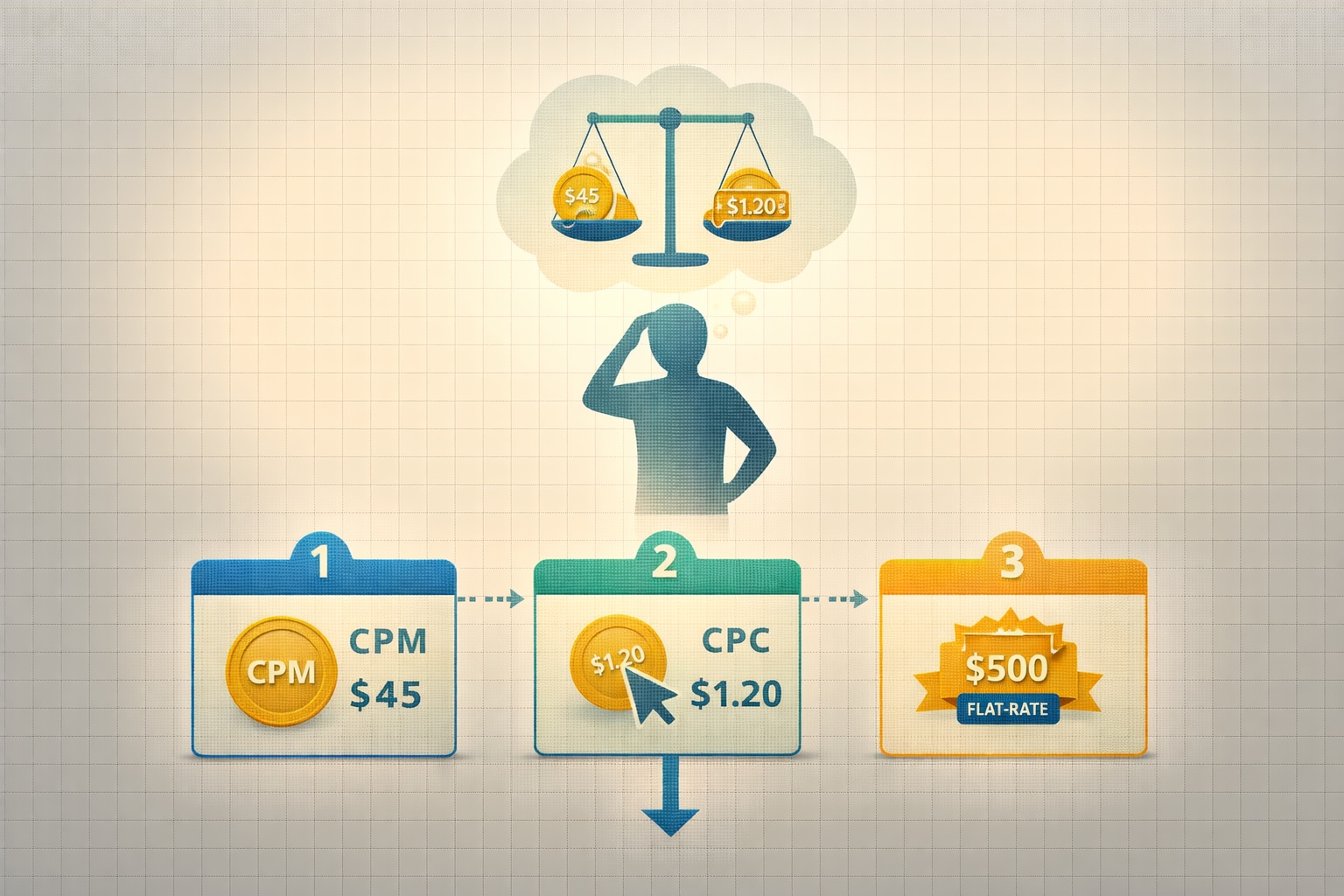
CPM—cost per thousand impressions—is a familiar instrument from display advertising that adapts well to newsletters when measured on open‑based impressions and governed by standards. CPM is most effective in secondary placements, where auction dynamics can discover price and fill with minimal overhead. It thrives on diversity: different categories, offers, and creatives compete to reach a defined audience in a brand‑safe context. Over time, publishers learn which categories consistently clear at higher prices in specific sections, and can set floors accordingly without micromanaging every campaign.
The advantage of CPM is continuity. When a direct sponsor lapses or a send date slips, secondary placements can continue earning. The trade‑off is that CPM won’t match the per‑placement revenue of an exclusive top sponsorship, but it does not need to. Its role is to convert attention that would otherwise go unmonetized into incremental and learnings‑rich revenue.
Performance models: CPC and CPL
Performance models pay for clicks or leads. They reward clarity and friction‑free landing experiences. In B2B, they excel for webinars, checklists, and trials where the reader already has an active project. In consumer categories, time‑bound promotions and clear discount mechanics can work well without creating fatigue, so long as the cadence is modest and the fit is honest. The downside is volatility. If the offer misses the moment, the payout drops. For that reason, performance models are best used as a complement to a base of sponsorship and CPM rather than as the spine of a program.
Affiliate and commerce
Affiliate revenue turns influence into commissions when readers purchase products featured or endorsed by the publication. It is the most sensitive to trust. The bar should be high: only recommend products that match the editorial stance and the audience’s real needs. When done well, affiliate modules contribute meaningful upside in seasonal cycles without overshadowing the editorial mission. When done poorly, they erode credibility fast.
Hybrid strategies
The hybrid that consistently works looks like this: reserve the top spot for an exclusive sponsor when sold; maintain a single mid‑content placement that runs either the sponsor’s secondary unit or programmatic demand; keep a footer slot for incremental CPM or small experiments. This structure concentrates attention where it belongs, preserves the reading rhythm, and creates a steady baseline of revenue across sends.
Audience size and the metrics that actually close deals
Many publishers overestimate how much raw list size matters. Advertisers are more persuaded by consistent engagement and proof that readers act. The core metrics are simple: unique opens per send, unique clicks per send, and click‑through rate by placement. Secondary signals—send cadence, list growth stability, and complaint rates—tell a story about predictability and quality.
A small but focused list can command premium rates in the right vertical. A 5,000‑subscriber developer newsletter with a 50% open rate and a 3–5% top‑placement CTR is often more valuable to a dev‑tools company than a general tech list ten times the size with diffuse interests. The narrative that sells is not “we are big.” It is “we are right for the buyer you care about, and we can show you how our readers behave.”
For publishers between 10,000 and 50,000 subscribers, the opportunity is packaging. A clear rate card with options for single send, two‑send tests, and four‑send bundles gives advertisers a ramp. Publishing brief case synopses—with category, creative example, CTR range, and landing‑page behavior—moves conversations from theory to risk management. At 100,000+ subscribers, the task becomes standardization: enforce creative standards, establish quarterly sponsorship calendars, and offer segment‑specific buys that reflect the lists within the list (e.g., finance pros, founders, data leaders).
Ad formats and where they belong
Format is not a matter of taste; it is a function of how readers consume the publication. The top placement is precious and should remain singular. It can be a visual banner or a native unit styled to match the publication if the voice carries more weight than graphics. What matters is that it communicates one idea quickly and points to a landing page that continues the promise.
Mid‑content placements perform best when they align to a recurring section: a tool of the week, a market snapshot, a case study corner. Readers are already in decision mode in those parts of the publication. A clear, relevant offer meets them there with minimal friction. The footer is a gentle space for incremental experiments, consistent programmatic presence, or a simple native line that rewards persistent scrollers without distracting earlier reading.
Regardless of format, label sponsored material clearly and consistently. Use visual framing that allows readers to recognize an ad at a glance without feeling tricked. Consistency is a service, not a tell. It keeps scanning efficient and trust intact.
Direct deals and programmatic are complementary
It is a mistake to frame direct and programmatic as opposing approaches. Direct sponsorships justify premium pricing because they buy certainty, creative collaboration, and editorial adjacency. Programmatic brings continuous demand, price discovery, and resilience. The best programs use direct to anchor the top placement and programmatic to keep the rest of the template earning with minimal overhead. When the direct pipeline is tight, programmatic smooths the gaps. When the pipeline is strong, programmatic still discovers new categories and creatives that can become future sponsors.
Operational setup: inventory, standards, and governance
Before a single ad runs, capture the operating rules. Write an ad map that specifies placements by name and purpose—Top Sponsor, Mid Context, Footer—along with how often each can appear per send. Define a category policy that lists allowed and disallowed topics, with notes for sensitive areas that require extra scrutiny. Establish frequency caps to prevent any single advertiser from dominating consecutive sends. Set creative standards that cover file sizes, typography limits for native units, alt text and accessibility expectations, and landing‑page requirements such as message match and load speed.
Governance sounds heavy, but it saves time. With standards published, sponsors know what to deliver, sales knows what to promise, and operations can say no without debate when something does not meet the bar. Over time, these standards can evolve as performance data suggests revisions, but the baseline remains stability and reader respect.
Pricing: from logic to numbers
Pricing is where many programs lose confidence. The antidote is to tie numbers to observable behavior and to present ranges rather than single points. For the top sponsorship, start from average unique opens over the last four to eight issues. Multiply by the historic CTR range of the top placement to estimate expected unique clicks. Consider the advertiser’s category and the implied value of a click to that category in your vertical. Present a fee that makes sense for both sides and offer a two‑send test at a modest discount to de‑risk first‑time buys.
For programmatic CPM, set initial floors by placement based on early results and adjust quarterly. In a mid‑content slot with strong contextual alignment, floors can be meaningfully higher than in a generic footer. Publish the logic in your media kit in plain language. When advertisers understand why a number exists, they are more likely to treat it as a boundary rather than a haggling point.
Step‑by‑step implementation: a 15‑minute launch
Launching should not require a redesign. Begin with the mid‑content placement to minimize risk. Insert a clearly labeled section in the template where the ad will render, using a no‑code embed provided by your ad platform or a simple code block if your ESP expects it. Preview across desktop and mobile clients. Send to a staging segment that includes common providers so you can inspect rendering, alt text, link behavior, and labeling in the wild.
For the first live send, roll out to a small percentage of the list. Compare CTR and complaints to the previous baseline. If results are stable or better, deploy to the full list on the next send. Only after several smooth sends should you consider introducing a second slot or moving the top sponsorship into place for a paid test.
Optimization: how to improve without compromising experience
Optimization is easy to get wrong by changing too much at once. The discipline is to run small, clear tests. When testing creative, change a single variable—headline clarity, CTA verb, image versus native text—and leave the rest alone for two to three sends. When testing placement, alternate the order of top and mid only if the issue’s content mix is stable; otherwise, content variance will swamp the effect. Keep a simple log of what changed and when, and read it monthly alongside performance dashboards. The goal is not to find hacks; it is to learn what your specific audience respects and responds to.
Frequency requires vigilance. If complaints or unsubscribes nudge upwards following an inventory change, listen. Reduce density, rotate categories, or revisit the creative standards. Long‑term list health is the leading indicator of sustainable revenue; sacrificing it for a single lift is a poor trade.
Scenarios: applying the framework to different stages
Consider a niche publication with 5,000 subscribers and a 50% open rate. With roughly 2,500 open‑based impressions per send, a single top sponsorship priced against a conservative CTR range can fund operations if it reliably renews. A footer slot running CPM can add steady incremental revenue without distracting from the core experience. The key is to over‑deliver on fit for sponsors in a narrow category and to publish renewal‑friendly results after each campaign.
A general‑interest newsletter at 25,000 subscribers and a 35% open rate has a different profile. The top placement can be sold, but the middle of the template—aligned to a recurring, high‑engagement section—is where programmatic shines. With careful floors, that mid slot becomes the engine of consistency that pays even when the hero is unsold. The footer, meanwhile, becomes a proving ground for categories that might graduate to direct sponsorship.
At 150,000 subscribers and above, operations become the bottleneck. The solution is process: standardize assets, institute monthly creative office hours for sponsors, enforce calendar discipline, and set aside a modest share of inventory for experimentation that is never allowed to expand beyond pre‑set limits. The objective is to avoid growing ad count faster than audience tolerance.
Reader trust and editorial integration
Trust is not a soft concept in newsletters; it is an operating constraint. Readers will not hesitate to leave if the experience becomes noisy or manipulative. The antidote is clarity. Label sponsored content plainly. Keep typography and spacing consistent so that paid placements feel like part of the publication’s visual system without masquerading as editorial. Avoid inserting ads between a headline and its first paragraph or in the middle of a sentence‑level transition where the interruption is jarring. Build muscle memory in the layout so the presence of a sponsor never feels like a trap.
It is also useful to listen explicitly. Periodic, short surveys about ad relevance and format preferences teach more than dashboards alone. If readers tell you that certain categories feel out of place, believe them and adjust. The reward is not only lower complaint rates but higher performance, because relevance and respect are causally related in the inbox.
Measurement that leads to better decisions
Measure what email can tell the truth about. Use open‑based impressions for denominators. Track unique clicks, CTR by placement and category, eCPM, and revenue per open. Compare these figures week over week and month over month, knowing that topic and calendar effects will create noise at the single‑send level. When judging a sponsorship, compare it to past sponsorships in the same placement and similar issues, not to a different format or a different time of year. When evaluating programmatic floors, look at the distribution of clearing prices by category and placement rather than an average alone.
Beyond performance, monitor list health: complaints, unsubscribes, and spam‑folder signals. These are the costs of doing monetization poorly. A program that grows revenue while holding or improving list health is winning, even if it forgoes the occasional high‑paying but ill‑fitting campaign.
Common pitfalls and how to avoid them
The most common trap is to add more ad units when results sag. This almost always backfires. It reduces the perceived quality of the publication, depresses click‑through rates through competition and fatigue, and can invite deliverability issues. Another pitfall is inconsistency: changing labels, moving placements without warning, or letting creative standards slide for a quick win. Inconsistency trains readers to disengage because they cannot rely on rhythm.
A quieter but equally damaging error is neglecting the landing page. If the page does not match the promise of the ad instantly—above the fold, in plain language—performance will suffer regardless of how good the creative is in the email. Tighten the message match and remove distractions. Make forms short. Make next steps obvious.
Where a privacy‑first platform fits
A platform designed for the inbox should be privacy‑first, lightweight, and governed by controls that keep publishers in charge. That means no hidden trackers or heavy scripts, predictable rendering, category approvals, frequency caps, and creative baselines that protect reader experience. It also means a simple path to production: a no‑code embed that integrates with major ESPs and a lightweight API for advanced cases. The goal is to make it easy to run the hybrid model that has proven durable: premium direct sponsorships plus continuous, well‑governed programmatic demand in secondary placements.
A practical roadmap you can adopt this month
Start with the map: name the placements, write the category policy, and publish creative standards. Implement a single mid‑content slot with a clear label and push it live after a staging test. Watch performance and list health across two to three sends. If the program holds steady, bring an exclusive top sponsorship to market with a two‑send test offer and move the mid slot to mixed duty—sponsor secondary or programmatic when unsold. Revisit floors and packaging after a month of data. Keep a log of changes and resist the temptation to chase novelty when consistency is what builds trust and revenue.
In ninety days, this disciplined approach creates a self‑correcting system. The organization understands how placements perform, advertisers see outcomes rather than opinions, and readers still recognize their favorite publication. That is the point: make monetization an extension of the editorial craft rather than a bolt‑on. Do that, and the newsletter remains a product people invite into their day—and one that pays its own way.